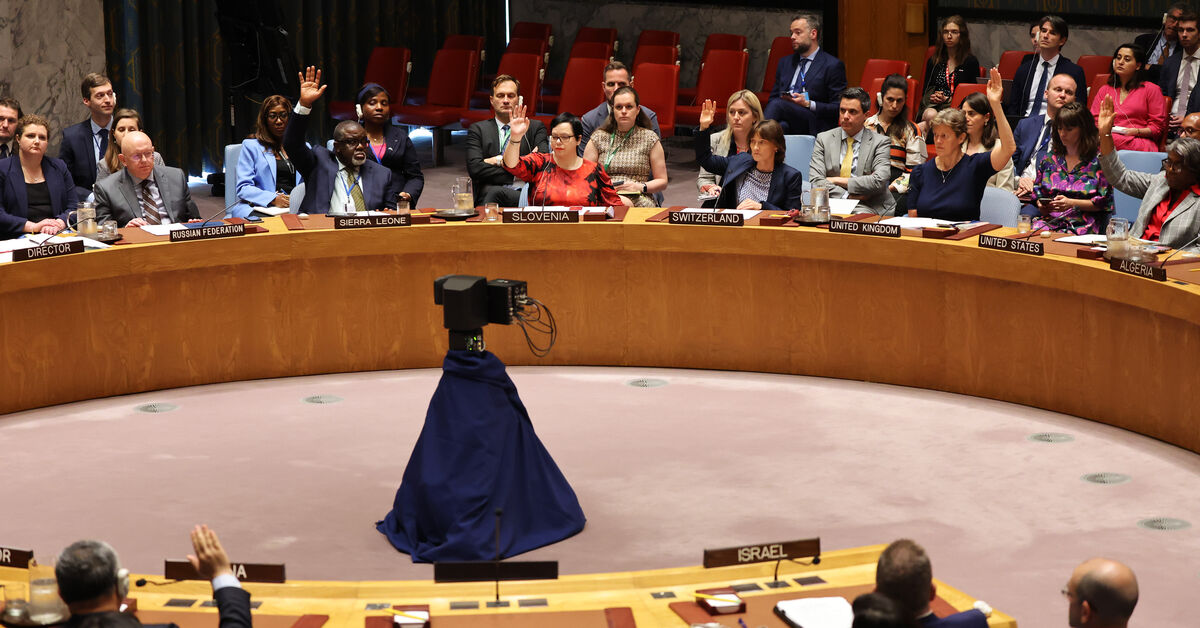

WASHINGTON — The United Nations Security Council on Monday adopted a US-drafted resolution urging Israel and Hamas to fully implement the cease-fire proposal that President Joe Biden announced more than a week ago.
The resolution, which passed the UN’s top decision-making body with 14 votes in favor and one abstention from Russia, “calls upon” Hamas to accept the latest proposal to end the eight-month war. The resolution also “urges both parties to fully implement” the cease-fire “without delay and without condition.”
The Palestinian militant group hasn’t formally responded to the proposal since it was made public on May 31. But shortly after the vote, Hamas said in a statement that it welcomed the resolution’s passage and was ready to cooperate on indirect negotiations over a permanent cease-fire. US officials have described the latest offer as nearly identical to Hamas’ own proposals.
“We need Hamas to agree to the cease-fire deal. And then we need Israel and Hamas to implement the deal without delays or conditions,” US Ambassador to the United Nations Linda Thomas-Greenfield said before the vote.
“I don’t want to keep waking up to news reports of more fighting and more loss of life,” she added.
If implemented, the three-phase proposal could see the return of the more than 100 remaining hostages, the full withdrawal of Israeli troops from Gaza and a major reconstruction of the coastal enclave.
But transitioning from stage one’s temporary cease-fire to stage two’s permanent “cessation of hostilities” would require both sides to overcome a seemingly intractable sticking point. Hamas wants a permanent end to the war as part of any hostage deal, whereas Israeli Prime Minister Benjamin Netanyahu has said there will be no cease-fire until the group’s military and governing capabilities are destroyed.
In the days leading up to the vote on Monday, the United States made several changes to the resolution following pushback from Israel. After an earlier version said the cease-fire proposal was “acceptable to Israel,” it was amended to specify that Israel had “accepted” the deal on the table.
The United States also watered down the text to remove language that rejected the establishment of a potential security buffer zone along Gaza’s border with Israel.
“The timing of this is particularly interesting,” said Maya Ungar, UN analyst at the International Crisis Group. “It seems that the US was not consulting as closely with Israel as in the past, as the draft resolution was amended to address Israel’s concerns after being circulated to other member states.”
The US-led resolution, which emphasized “the importance of the ongoing diplomatic efforts by Egypt, Qatar and the United States,” passed the same day Secretary of State Antony Blinken arrived in the Middle East for his eighth visit to the region since Oct. 7.
Following a meeting in Cairo with Egyptian President Abdel Fattah al-Sisi, Blinken urged regional governments to pressure Hamas to accept the cease-fire proposal.
“My message to governments throughout the region, to people throughout the region, is if you want a cease-fire, press Hamas to say yes,” Blinken told reporters before departing for Israel.
Earlier in the war, the United States used its veto power to block several other resolutions calling for Israel and Hamas to reach an immediate cease-fire. Under international pressure, the United States abstained from a vote in March, allowing the passage of a cease-fire resolution supported by the rest of the 15-member council.
The United States also used its veto in April to block a Palestinian bid for full membership at the United Nations. The UN General Assembly then voted overwhelmingly to grant Palestine additional privileges and called on the Security Council to reconsider its request for full membership.