
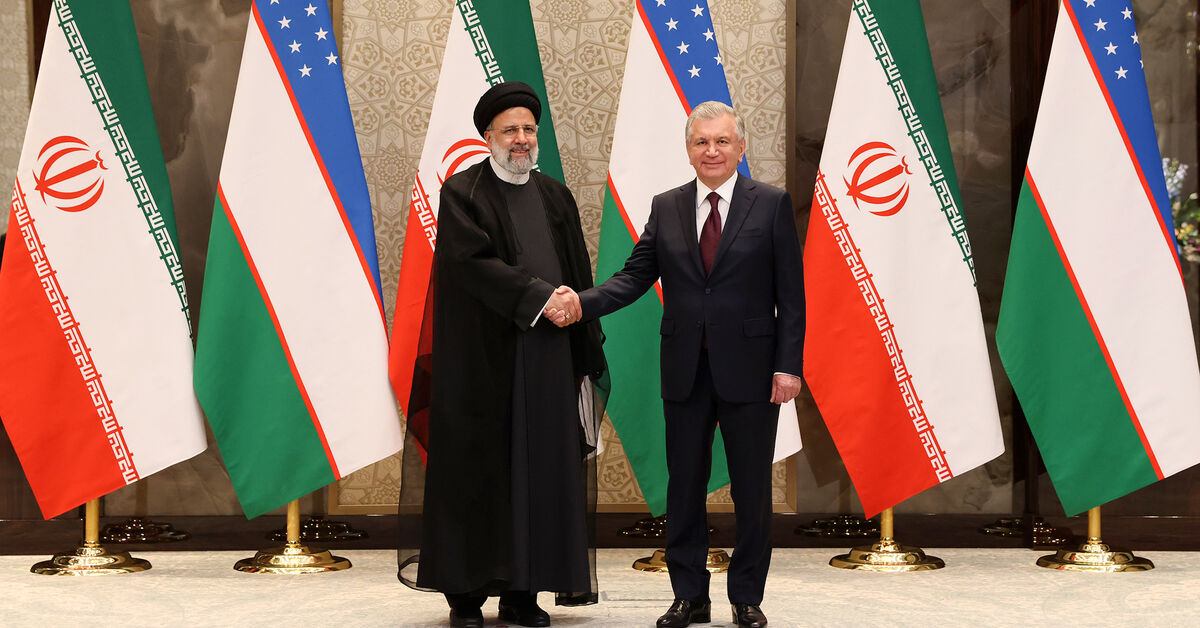

TEHRAN — Iran and Uzbekistan issued a joint statement citing 10 agreements to strengthen their bilateral economic cooperation, as Uzbek President Shavkat Mirziyoyov sat down with his Iranian counterpart, Ebrahim Raisi, on Sunday.
According to the government-run IRNA news agency, the agreements cover a wide range of areas such as energy, transit, technology, agriculture, the pharmaceutical industry and insurance.
The two sides also signed a document on preferential trade, with Raisi calling on ministers from both sides to list commodities to be covered in such an arrangement within two weeks. He said Tehran and Tashkent were now looking to push the boundary on their trade volume, aiming for an annual $3 billion.
In 2021, the value of the two countries’ trade stood at $431 million, according to Iranian official data.
The Uzbek delegation also agreed to start negotiations with their Iranian counterparts on launching joint free trade zones, while oil ministers signed a roadmap on gas and petrochemical industries with a focus on downstream operations.
Preparations for the oil roadmap had been underway since last September, when Raisi was in the Uzbek city of Samarkand to attend a summit of the Shanghai Cooperation Organization to complete the long-awaited Iranian ascension to the bloc as part of the Islamic Republic’s ambitious push for regional engagement.
Iran’s economy has been in shambles since the 2018 US abandonment of the Iran nuclear deal. The departure reinstated one package of sanctions after another that Iran had been expecting to replace with economic dividends through the deal.
Yet Raisi praised his country for managing to transform “the threat and pressure” of those sanctions into “opportunities,” which he said Iran is now willing to “share” with regional states. The offer, according to Iranian media, was welcomed by Mirziyoyov, whose Tehran visit was the first of its kind by an Uzbek leader in 20 years. He told his Iranian counterpart that Tashkent was hoping for investment by the Iranian private sector in its economic projects.
Mirziyoyov also separately met with Iran’s Supreme Leader Ayatollah Ali Khamenei, who has the ultimate say in Tehran’s key state matters.
“The Islamic Republic does have the capability to easily connect [landlocked] Uzbekistan to international waters through Turkmenistan and Afghanistan,” Khamenei’s official website quoted him as saying.
The report fell short of specifying if Khamenei had elaborated on the technicalities or how the Uzbek leader had responded to the offer.


