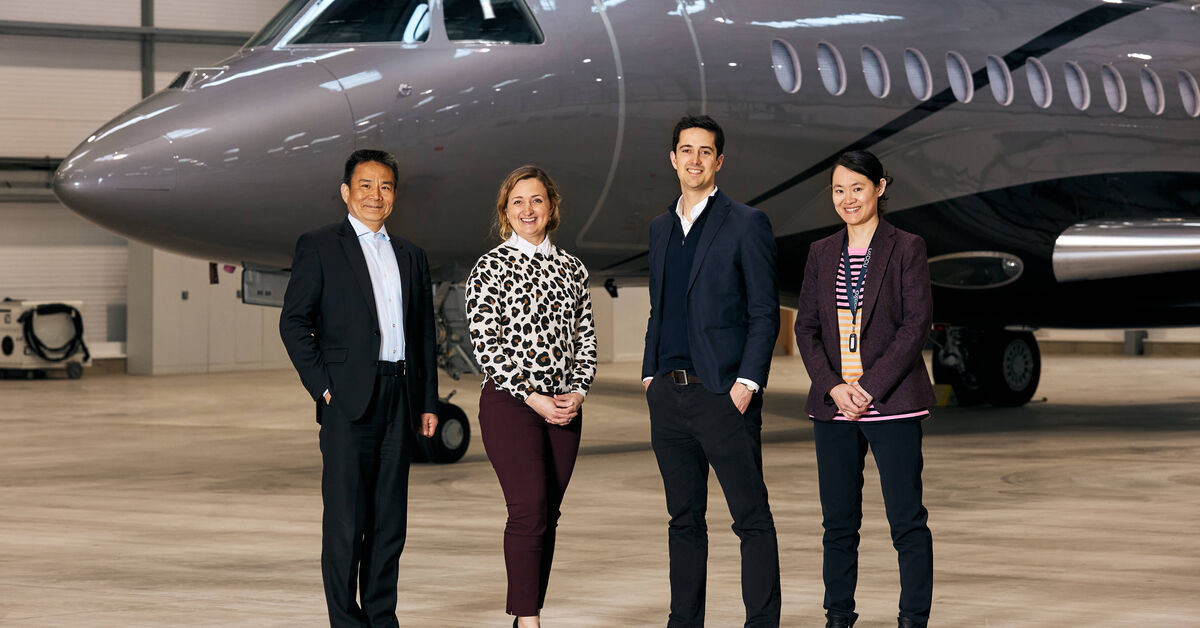

The venture capital units of oil firms Aramco and ENI and US carrier United Airlines invested $22.7 million in a British startup earlier this month.
The startup, called OXCCU and founded in 2021, is looking to lower the cost of low carbon aviation fuel to make it a more attractive option for airlines to buy instead of fossil fuels. Oxford University-affiliated scientists working with the company are doing this by fusing carbon dioxide (CO2) and hydrogen together to make sustainable fuel that can eventually be mass-produced.
The company’s process can also help manufacture chemicals and plastics, as well as shipping fuel, in a more sustainable way.
The investment is helping the startup make new catalysts, demonstration plants and reactors to turn CO2 into fuel on a mass scale, the company’s CEO Andrew Symes told Al-Monitor in an interview. One of the plants will be at Oxford Airport in the United Kingdom, close to a potential airline customer base.
The funding will also help expand the startup’s team that will be working in the plants, Symes said. The team will nearly double from around a dozen to 20 people.
The corporations that have invested — including Saudi Arabia’s Aramco, the world’s largest oil company — are interested in the future of carbon-neutral hydrocarbons, Symes said.
Aviation accounts for 2% of the world’s carbon emissions. “Everyone wants to carry on flying but without the climate impact,” he said. “So, the answer is SAF [sustainable aviation fuel] because the existing infrastructure works and it’s very safe and everyone’s happy with it.”
There is a dearth of SAF available, and only a handful of airlines have used it so far — and only for the occasional flight rather than for full operations. The fuel tends to be made from feedstocks in limited supply, such as vegetable oil. But producing SAF at scale can mean that arable land can be lost, threatening the food supply. There is a far greater supply of CO2 for this purpose.
The company’s process for making the fuels reduces the Capex (capital expenditures) and Opex (operational expenditures), which allows for cheaper e-fuel that can be more competitive with the price of fossil fuels, Symes said.
“Over time, we aim to increase the percentage of CO2-derived fuel in the aviation fuel mix,” he added.
In the long term, Symes wants OXCCU to take CO2 from the atmosphere using air capture methods, but the technology has not evolved enough yet. This process would be fully circular, but Symes said that it is still “quite a few years away.”
OXCCU currently uses biogenic CO2, which comes from industrially sourced biomass. But instead of using the starch or oil that is in the plant to power airplanes, all the carbon from it would be used and a lot of that would be carbon dioxide.
“You’ve gone from a fossil fuel to an industrial plant to CO2; CO2 has then gone back to a fuel, gone back to a plane, and then it goes in the atmosphere,” he said. “So it’s still linear, but you’re getting almost two uses out of it rather than one use. And that’s clearly a benefit, and … it stops us having to dig up more and it reduces the amount of CO2 going into the atmosphere.”
Saving water in the Middle East
The Middle Eastern market could potentially benefit from OXCCU’s fuel because the amount of solar resources in the region means that the cost of green hydrogen should be relatively low.
“I think Saudi Aramco is interested in making e-fuels as well as obviously selling fossil crude oil,” he said. “I should be clear that there’s no commercial agreement in place with ENI or Aramco, but they need to see our demo plants work first. But certainly, the reason for their investment is they’re interested in combining solar and water to make hydrogen, and then that with CO2 to make hydrocarbons.”
Furthermore, the Middle East is a water-constrained region. Making green hydrogen for fuel by traditional methods involves extracting it from water, which is all lost in the process. But Symes said his process only consumes a third of the water. “When we make fuel, the CO2 reacts with the hydrogen and the oxygens on the CO2 get back to making water. So you get two-thirds of the water back.”
OXCCU now needs to prove its SAF can be mass-produced. Once it has scaled up, it wants to be able commercially to sell its product to the industry. The Middle East could be a good destination for it, Symes said, noting that there has been increasing interest from Middle Eastern companies due to the COP28 climate conference being held in the United Arab Emirates in November.
“So currently, they [energy industry] own the refineries and the pipes and the ships. And what we’re saying to them is [that] you can still use a lot of that, but you need to change the inputs. And the inputs were historically dug up from the ground. And we’re saying [to] use CO2 and hydrogen for the inputs instead,” he said.
There is controversy around the entities that are funding the project — including Aramco, the world’s biggest polluter, as well as United, a major airline. Questioned about that, Symes said the company is “passionate” about trying to get to net zero and is not advocating for fossil fuel use being beyond what is necessary.
“But I would say we’re kind of looking to try and give these companies a way for them to use their existing infrastructure, but without the climate impact,” Symes said.
“We also want these hydrocarbons to be used for the sectors that really need them. Any sector that can be electrified directly should be so we’re not interested in pursuing this as a way to keep electric vehicles off, off the cars, we need electric vehicles,” he added.
“What we’re saying is there are the seven sectors where we won’t be able to electrify and, in those sectors we need CO2-derived hydrocarbons rather than fossil-derived hydrocarbons,” Symes concluded. “In those sectors, we want to work with the existing industry and we want to use the existing infrastructure to get [e-fuel] to customers.”