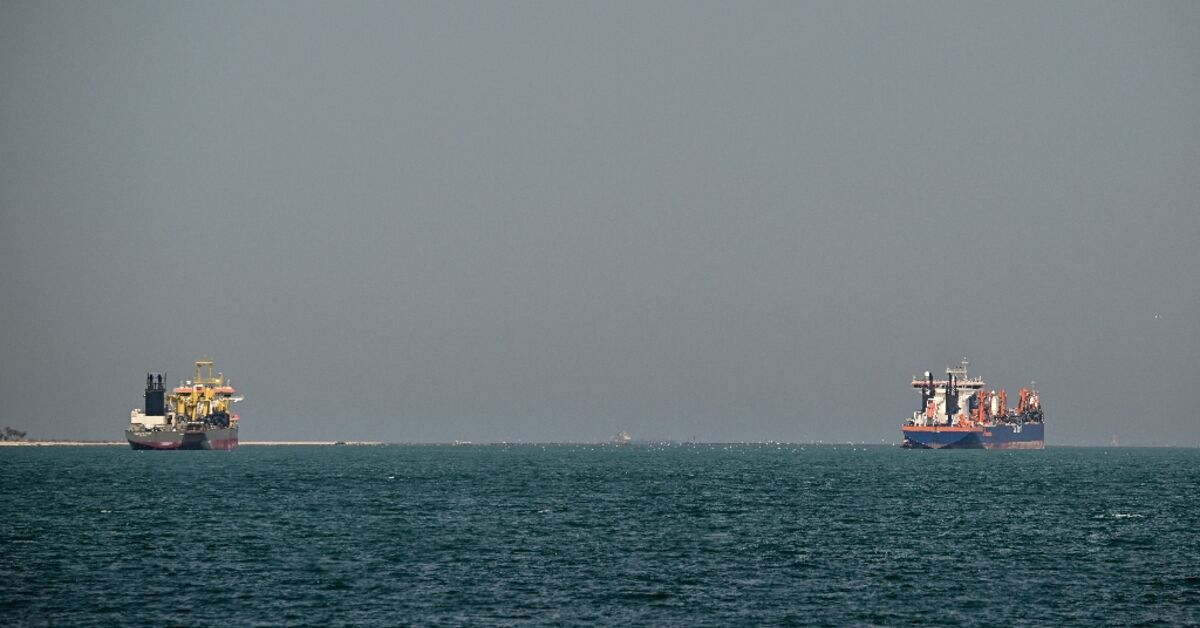

Just a trickle of cargo ships and tankers — most of them Iranian — have made it through the Strait of Hormuz since Iranian forces effectively blocked the crucial trade route in the Middle East war.
Here are facts and figures about vessels that have passed through the 167-kilometre (104-mile) long strait since the war broke out with US-Israeli strikes on Iran on February 28.
– 95% shipping drop –
From March 1 to 1600 GMT on March 23, commodities carriers made just 144 crossings, according to analytics firm Kpler — a 95 percent decrease from peacetime.
Of these, 91 crossings were by oil and gas tankers and more than half were loaded, Kpler data showed, with most travelling east out of the strait.
“Traffic through the Strait of Hormuz continues to be severely disrupted,” shipping intelligence journal Lloyd’s List said in its latest update Monday.
On Monday, two Indian-flagged tankers carrying liquefied petroleum gas (LPG) and a China-bound carrier were among the latest to navigate the strait, according to Kpler.
The Panama-flagged Bright Gold was due to arrive in China on April 13 with around 40,000 tonnes of methanol.
A Chinese-owned containership — the Newvoyager — also transited the waterway after making a payment to Iranian authorities, Lloyd’s List reported.
The exact amount and method of payment could not be confirmed, it said.
– New approved route? –
Monday’s crossings all appeared to have used a purported Tehran-approved northern route around Larak Island just off the Iranian coast.
Lloyd’s List updated Monday that it has tracked more than 20 ships using the so-called corridor, with the majority Greek-owned but others Indian-, Pakistan- and Syrian-owned.
It added that the Iranian authorities are reportedly handling transit requests on a case-by-case basis while some governments, including India, were said to be negotiating with Tehran for bulk passage arrangements.
At least one vetted vessel paid a reported $2 million payment to pass safely through the strait, Lloyd’s List reported last week.
Two of the vessels navigating it Monday — the Bright Gold and the Indian tanker Pine Gas — kept their AIS transponders on, a rare occurrence for a non-Iranian vessel in the current climate.
– Iranian, Greek, Chinese ships –
The biggest proportion of ships to have passed through the strait are owned or flagged in Iran, followed by Greek and Chinese carriers, Bridget Diakun, an analyst at Lloyd’s List Intelligence, said last week.
“Although Iran is continuing to control the Strait and exit its own oil, everything else is largely still at a standstill,” Meade previously noted.
– 51 sanctioned ships –
Since the war started, more than 40 percent of the ships transiting the strait have been under US, EU or UK sanctions, according to an AFP analysis of passage data.
Of the oil and gas tankers, nearly 59 percent were under sanctions.
Since March 16, “anything heading westbound has been shadow fleet, gas carriers or tankers… they absolutely dominate the traffic going through,” Diakun told the Lloyds briefing.
– Oil, LNG to Asia –
Commodities analysts at JPMorgan bank have noted that most of the oil passing through the strait was headed for Asia, principally China.
Cichen Shen, Asia Pacific editor at Lloyd’s List, said there were indications online that Chinese authorities were working on “some sort of exit plan” for their big tankers stuck in the region.
Meanwhile, Europe-bound LNG cargoes have been diverted to Asia, according to MarineTraffic.
It noted that around 11 LNG tankers originally bound for Europe have been diverted to Asia since March 3, according to its analysis of market data, amid restricted supply and rising spot prices.
– 1.3 mn barrels of Iran oil –
The JPMorgan analysts said overall 98 percent of the observable oil traffic through the strait was Iranian, averaging 1.3 million barrels a day “in early March”.
A fifth of the world’s oil and liquefied natural gas passes through the strait in peacetime.