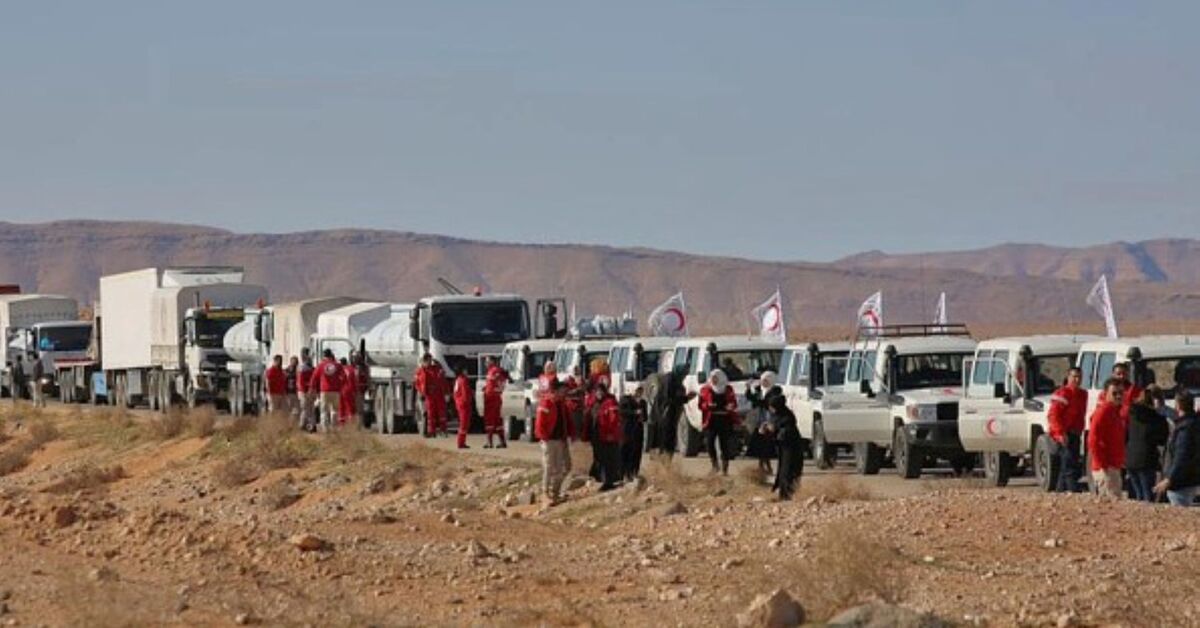

The US military has begun delivering aid purchased by a Washington-based nonprofit organization to Syria’s Rukban camp after years of encirclement by the Assad regime.
The Syrian Emergency Task Force, a US-based charity organization, purchased the aid in Iraq and delivered it to Al-Asad Airbase in Iraq’s Anbar province, where it was loaded onto three American military aircraft that have arrived at the US Al-Tanf garrison since Saturday.
Nine pallets of aid have been delivered so far, including fertilizer, seeds and irrigation equipment to enable local families to grow their own food in the desert camp, according to Mouaz Moustafa, director of the SETF.
The organization also plans to provide schoolbooks and classroom supplies for all children in the camp, said Maria Cure, a SETF volunteer.
In a first, the aid was loaded onto US military aircraft with excess space already scheduled to head to Tanf from Iraq, under a protocol approved by the US State Department and USAID.
Capt. Abigail Hammock, spokesperson for US Central Command, confirmed to Al-Monitor via email that the military facilitated SETF’s effort “by assisting with the transportation of life-saving aid to the Rukban camp.”
The transportation is on a space-available basis, Hammock said, and will not affect the US-led coalition to defeat the Islamic State.
Why it matters: The shipment marks a breakthrough in humanitarian efforts to deliver aid to Rukban, where an estimated 8,000 people live in makeshift dwellings, most without running water.
The Assad regime has long blocked UN aid from reaching Rukban, only allowing humanitarian convoys to reach the settlement on a handful of occasions since 2017. The last UN aid convoy arrived in Rukban in 2019.
A source speaking to Al-Monitor from the Rukban camp on Tuesday confirmed the delivery, saying it was the first such aid package to arrive in over a year and that more was expected in the coming days.
Subsequent US administrations have failed to provide humanitarian aid to Rukban, relying instead on the UN process, which depends on permission from the Assad regime in Damascus.
Despite criticism that the US military is obliged under international law to provide care to civilians in territory under its control, the Trump administration refused to enlist American forces at the nearby Al-Tanf garrison to provide substantial cross-border aid.
US troops at Al-Tanf, which lies just a few miles from Rukban, have supported basic humanitarian projects via intermediaries in the camp, but have avoided the site, except for providing medical care in exceptionally rare situations.
At its peak, Rukban held more than 60,000 people seeking access to the closed Jordanian border and the protection of US military. Faced with food and water shortages, rampant malnutrition and disease, the majority returned to territory controlled by the Assad regime or fled to other parts of Syria via smugglers.
“At the end of the day, this is still not the United States government. It’s not the United Nations,” Moustafa told Al-Monitor. “It’s American people who donate to an American organization that’s doing this. We’re hopeful that maybe this inspires a change in policy for the United Nations or the administration.”
What’s next: SETF has delivered about two-thirds of the first batch of aid to Rukban. The group intends to send additional aid on future US military transport flights, including schoolbooks, food baskets, baby formula and prenatal vitamins, Cure told Al-Monitor. “We expect to send more items regularly if a space is available on these aircraft.”
Al-Monitor has reached out to the State Department for comment.
Know more: Cross-border aid protocols have been shifting in other parts of Syria as well.
Following a devastating earthquake in February, the Assad regime allowed aid via additional sites other than the UN-mandated Bab al-Hawa crossing linking opposition-held northwest Syria to Turkey.
The UN is expected to vote on extending cross-border aid authorization for the Bab al-Hawa crossing in the coming weeks.
The Biden administration announced $920 million in additional humanitarian assistance for Syria last week, its largest single contribution to date.