
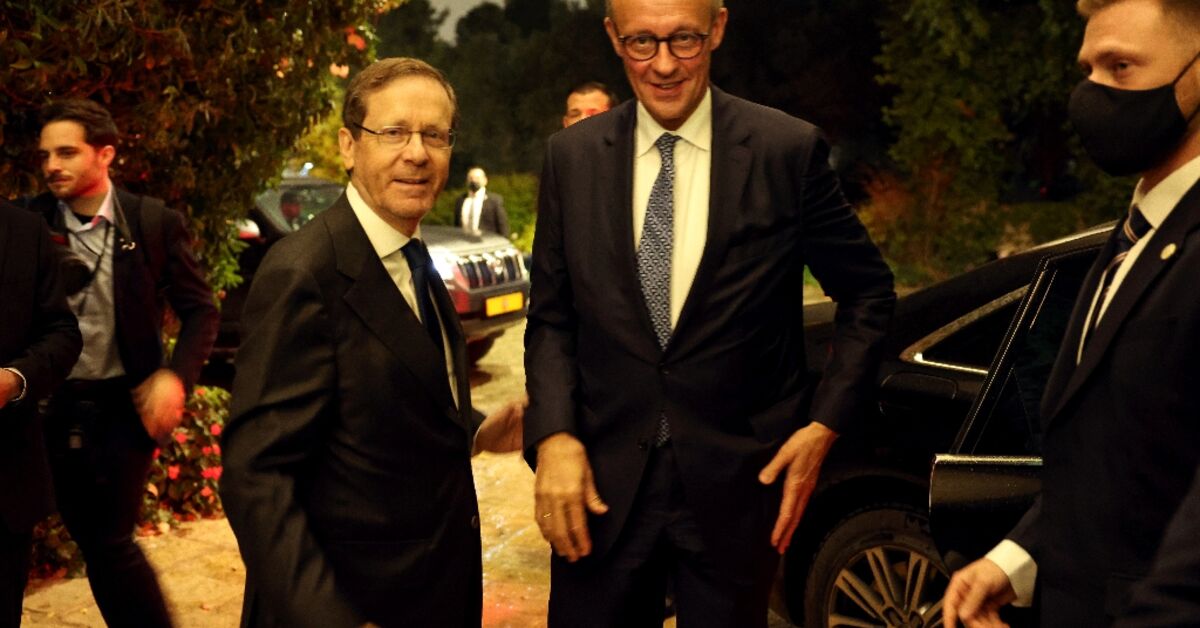

German Chancellor Friedrich Merz flew into Israel Saturday for his first visit since taking office, and reaffirmed Berlin’s support after traditionally solid ties between the countries were shaken by the Gaza war.
Merz landed at Tel Aviv’s Ben Gurion airport just before 8:00 pm (1800 GMT) and was met by Israeli Foreign Minister Gideon Saar, who called him “a friend of Israel”. Germany, he added, was “an important partner”.
Merz met Israeli President Isaac Herzog in Jerusalem later Saturday.
“I consider it a great honour and a truly great distinction to be here and to reaffirm that standing by this country is and will remain the unchanging core principle of the Federal Republic of Germany’s policy,” said Merz.
Earlier Saturday, Merz held talks with Jordan’s King Abdullah II during a brief stopover there. Their discussions focused largely on the fragile peace process in Israel and the Palestinian territories, he told reporters.
Merz urged more humanitarian aid to flow into Gaza and for Hamas fighters to lay down their weapons, adding that both Jordan and Germany remained committed to a negotiated two-state solution.
“There can be no place for terrorism and antisemitism in this shared future,” Merz said.
Jordan’s royal palace said in a statement that Abdullah had stressed “the need to commit to implementing all stages of the agreement to end the war and deliver humanitarian aid to all areas of the Strip”.
The king warned of “the danger of continued Israeli escalations in the West Bank”, which Israel has occupied since 1967.
Hamas said Saturday it was ready to hand over its weapons in the Gaza Strip to a Palestinian authority governing the territory, provided the Israeli army’s occupation ended.
“We accept the deployment of UN forces as a separation force, tasked with monitoring the borders and ensuring compliance with the ceasefire in Gaza,” Hamas chief negotiator and its Gaza chief Khalil al-Hayya added in a statement.
But he rejected the deployment of any international force in the Strip whose mission would be to disarm it.
– Ties shaken –
In Jerusalem on Sunday, Merz is scheduled to visit the Yad Vashem Holocaust memorial before meeting Prime Minister Benjamin Netanyahu.
Given the dark legacy of Nazi Germany’s industrial-scale murder of Jews, German leaders have long seen unflinching support for Israel as a bedrock of the country’s foreign policy.
But Israeli-German ties were shaken during the Gaza war set off by the October 7, 2023 Hamas attack on Israel which resulted in the deaths of 1,221 people, mostly civilians, according to an AFP tally based on official Israeli figures.
Merz, who took power in May, has repeatedly criticised Israel’s relentless military campaign, which has killed more than 69,000 Palestinians, according to the health ministry in the Hamas-run territory, figures the United Nations considers credible.
In August, he also moved to restrict sales of weapons for use in Gaza.
Since a fragile US-backed ceasefire and hostage deal ended full-scale fighting, Germany has lifted those export restrictions.
Despite the ceasefire, more than 350 Palestinians have been killed in Gaza, according to local health authorities, as well as three Israeli soldiers.
“The actions of the Israeli army in Gaza have posed some dilemmas for us (and) we have responded to them,” Merz said Saturday.
But, he added: “Israel has the right to defend itself.”
– Defence deals –
Although Merz’s public criticism of Israel was unusual for a German leader, it was measured by international standards.
Merz recently offered Israel full-throated support as European broadcasters considered whether to exclude the country from the annual Eurovision Song Contest, calling such a possibility “scandalous”.
Thursday’s decision to include Israel in the upcoming Eurovision event was warmly welcomed in Berlin.
Nevertheless, German officials have said there are currently no plans to invite Netanyahu to Berlin.
The Israeli leader faces an arrest warrant for alleged war crimes in Gaza from the International Criminal Court (ICC).
Earlier this year however, Merz vowed to invite the Israeli leader and told him he would not be arrested.
Nor have any tensions disrupted key military ties. Germany last week put into operation the first phase of the Israeli-made Arrow missile defence shield.
The $4.5-billion deal was reportedly the largest arms export agreement in Israeli history.
Before leaving Berlin on Saturday, Merz spoke with Palestinian Authority (PA) president Mahmud Abbas.
A spokesman said Merz underscored German support for a two-state solution but urged Abbas to push through “urgently necessary reforms” of the PA in order to play a “constructive role” in the postwar order.
burs-jj/acb

