
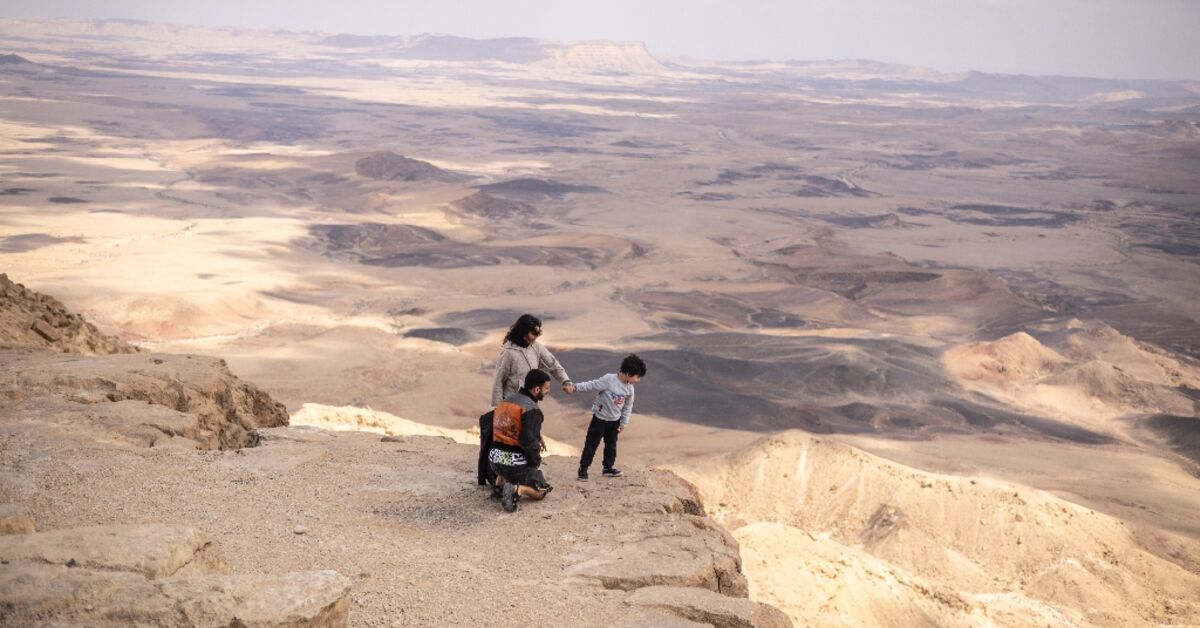

School counsellor Tair Momo took a deep breath as she stared out over the vast silence of the Negev desert in southern Israel.
“I came here to get some respite, to not hear the sirens, not hear the alerts, to be in a place of nature that feels more relaxed,” the 33-year-old told AFP.
As air raid sirens blare out warnings of Iranian missiles or Hezbollah rockets across much of Israel, residents of bigger towns and cities have packed out the small desert resort of Mitzpe Ramon in search of calm.
Perched on the cliffs above a 40-kilometre-long crater of sand and rock, the town of some 5,000 has been inundated by visitors who have booked out hotels and rental apartments.
Among them was Momo, who spent days waiting for some accommodation to come free before rushing here from her hometown of Kiryat Gat along with three friends.
“We just agreed: come on, let’s go,” she said.
Yaniv Harush, the general director of the local council, told AFP that Mitzpe Ramon has experienced just one alert since the beginning of the war with Iran on February 28.
“It’s like an island of peace and security,” he said, sitting in his modest office.
Usually Mitzpe Ramon draws visitors for its hiking, camping and relaxed hippish vibe. Impressively horned Ibex mountain goats roam freely through the streets.
Now, Hanush said that visitor numbers to the town were up by about 80 percent from normal times, with some 2,000 people having come to stay.
“Everything is full,” he said.
Sitting outside the packed cafe he owns, Sami Elkrnwi said all 100 of the rooms in the four hotels he runs around town are occupied.
“Business is great,” said the Bedouin entrepreneur. “There are no blasts here, everything is perfect.”
The latest conflict — which began when Israel and the United States attacked Iran — is not the first time Mitzpe Ramon has played host to Israelis in search of refuge.
In the wake of the attack by Hamas on October 7, 2023, the town welcomed residents from areas close to Gaza that had borne the brunt of the bloodshed.
Elkrnwi said that back then “I opened my hotel, everything free for the people” displaced by the attack.
– ‘Not a holiday’ –
Sitting nearby sipping coffee and eating cake with her husband and two daughters, Michal Gat had come to Mitzpe Ramon for the day from the village where they’d relocated to stay with relatives.
“We moved the morning the war started since our home is without any shelter,” said the resident of Israel’s commercial hub Tel Aviv.
Gat has continued managing her brand consultancy business remotely and stays in close contact with friends and neighbours back in the city.
“It’s not a holiday. You think about all the people you know,” she said.
“Our heart is totally with the people in the centre and also in the north of Israel.”
Her 18-year-old daughter Dror, said she was busy working with friends online on a performance for her school leaving prom in July.
Her generation has grown so used to remote classes — first during the Covid-19 pandemic, then due to repeated bouts of rocket fire — that they’re planning a skit about their “six years of Zoom”.
“I hope we can perform it properly in person,” she said.
Back across town on the lip of the vast crater, tech worker Haggai Landa was strapping up his harness and tying the ropes as he prepared to rappel down the 40-metre cliff with his two sons.
On the first night of the war the windows of their house in Tel Aviv were blown out by a nearby missile strike.
After spending their nights in a public shelter, he and his wife decided to pack up the children and head out to the desert.
“We get to sleep every night, the anxiety level is low. It’s an improvement,” Landa said.
In two days they were planning to head back to Tel Aviv to visit his mother and so the boys could see their friends.
“We go back with mixed feelings,” he said.
“If the war goes on and on, we may get out again and come back.”