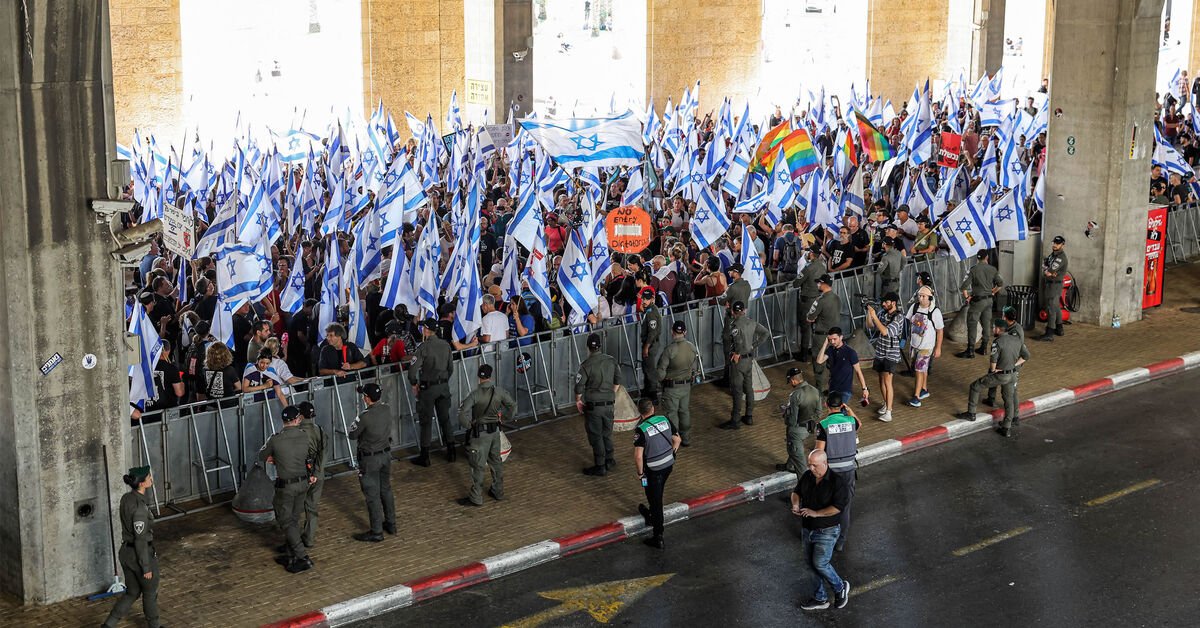

Thousands of protesters have been flooding the streets in several Israeli cities and at main highway junctions, protesting since Tuesday morning against the government advancing a legislation that nabs Supreme Court control over government decisions or appointments deemed unreasonable.
The proposed legislation is deemed by the government as an essential part of its judicial overhaul plan.
Protests started already Monday night, when Israel’s parliament adopted at a first reading the amendment to the Basic Law: The Judiciary. “Whoever has judicial authority according to law, including the Supreme Court, will not judge or issue orders against the government, the prime minister, a Cabinet minister or another elected official as determined by law, regarding the reasonableness of their decision,” the amendment states. In other words, the amendment cancels the standard of “reasonableness” in judicial review.
The amendment has yet to be approved at second and third Knesset readings in order to come into effect. The Knesset’s Constitution, Law and Justice Committee is expected to discuss the amendment proposal Tuesday afternoon/evening, and then vote on it at the end of next week. Once voted, the draft will be passed to the Knesset plenum for approval, apparently on July 30, the last day of the parliament’s summer session.
Protests across the country
Protesters gathered Monday night outside the Knesset and in other locations, calling on the government to avoid bringing the amendment to vote. Several protesters entered the building, and then tried to glue themselves to the floor, to prevent coalition members from entering the plenum. They were all removed from the site by the police. Anticipating Monday’s vote, organizers of the protest movement have been calling for days on people to join mass demonstrations on Tuesday, dubbed “Day of Disruption” or “Day of Resistance.”
Demonstrators started gathering early Tuesday morning across the country, marching with Israeli flags and blocking roads. Protesters tried blocking the Ayalon highway in Tel Aviv in both directions, but were stopped by police. Others tried blocking main traffic axis in the city. In Haifa, police stopped protesters who tried blocking the Carmel Tunnels. In several locations, police used water cannon vehicles to push back the protesters. Protesters managed to block the coastal highway in several locations. Many are also blocking the junction in front of the Supreme Court building in Jerusalem.
Israel’s public broadcaster KAN reported that dozens of demonstrators had been detained by police by early Tuesday afternoon, including a photographer of Yedioth Ahronoth newspaper. Police Commissioner Yaakov Shabtai told the press, “The police were prepared well ahead, handling over 100 protest sites. More than 50 people were detained. There is no change in policy or guidelines: As soon as the public does not listen to the guidelines and the balance between freedom of protest and freedom of movement is violated, then the necessary tools are activated.”
Israel’s Attorney General Gali Baharav-Miara had estimated earlier this week that the protesters are within their rights to request authorization to demonstrate at Ben Gurion Airport, an opinion largely slammed by several coalition members. Police had said it will enable protesters to demonstrate at the smaller Terminal 1, and not at the main Terminal 3, so as to minimize disruption to incoming and outgoing international flights.
Still, with hundreds of protesters arriving to Terminal 3, outside the departure floor, police had decided not to relocate them. For the moment, police enable the protesters to block one of the lanes leading to the terminal building. According to Ynet, several protesters managed to enter into the Terminal 3 building, with two of them claiming to have been subjected to rough police handling.