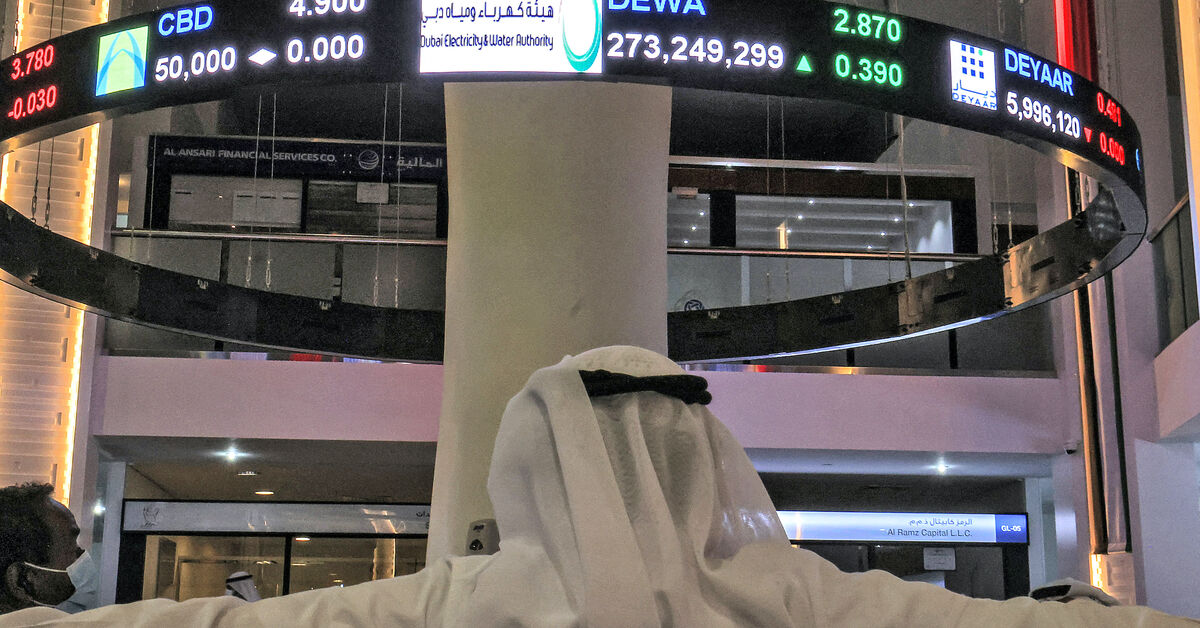

LONDON — Saudi Arabia is poised to raise more than $11.2 billion by selling shares in Aramco to help fund the government’s spending plans, despite the state-run firm pricing the stock at the lower end of expectations, the world’s largest oil company said Friday.
The pricing follows a week-long roadshow in London and New York led by Aramco Chief Executive Amin Nasser. Aramco also targeted Asian investors, encouraging them to buy into the deal.
Aramco had set a price range of its shares between 26.7 and 29.0 riyals ($7.12 and $7.73) but said on Friday it ended up pricing them at 27.25 riyals ($7.27).
A person familiar with the matter told Reuters that the offering was four to five times oversubscribed. Two other sources told the newswire that international demand was higher than it was for Aramco’s 2019 initial public offering (IPO) and included interest from China and elsewhere in Asia and Europe, another person said.
Aramco said in a statement it had listed 1.545 billion more shares, representing 0.64% of the company’s issued shares.
“Investing in Saudi Aramco strengthens the strategic partnership between China and Saudi Arabia, allowing Chinese investors to access the broader Middle Eastern market,” Xuyang Dong, a Chinese energy sector specialist at Australian think tank Climate Energy Finance, told the Financial Times. China is the biggest customer of Aramco’s crude.
Of the latest offering, 10% went to retail investors, while 90% went to institutional investors.
Aramco’s investor base has typically been Middle Eastern. The December 2019 IPO, which saw the sale of three billion shares, raised $25.6 billion — only 1.5% of the company’s then value of $1.7 trillion. The shares began trading only on the Tadawul, Saudi Arabia’s stock exchange. The IPO shattered records and became the world’s largest listing ever, surpassing the $25 billion raised by Chinese internet giant Alibaba in 2014. However, the deal fell short of a $2 trillion target valuation of the company set by Saudi Crown Prince Mohammed bin Salman. Due to the company being undervalued by international investors by about $300 million, the company did not list on global stock exchanges, as initially expected. The deal was originally due to take place in 2018, but it was postponed several times in hopes of bolstering investor confidence in the oil firm.
Aramco has been increasingly looking to China and focusing its business toward petrochemicals and liquefied natural gas (LNG). In March, the company reported that its profits fell 25% to $121 billion for 2023 after breaking a record in 2022 of $161 billion off the back of higher energy prices caused by the war in Ukraine.
Funding the vision
The proceeds from both of Aramco IPOs are helping fund the Saudi government in its ambitious reform agenda Vision 2030 to wean the kingdom off an economic reliance on oil by heavily investing in other sectors, such as entertainment, green energy, sports and tourism.
The Saudi Arabian economy, which in 2022 was the fastest growing in the G20, contracted by 1.8% in the first quarter of 2024. Much of this was due to the kingdom, the world’s biggest crude exporter, lowering oil output to nine million barrels per day (bpd) in mid-2023 in a bid to increase global oil prices. The economic theory was that lowering output would decrease supply compared with demand and thus raise prices. However, global demand growth for oil has remained sluggish in 2024, and oil prices are still only around $79 per barrel, a far cry from the triple-digit prices seen in 2022 after Russia’s invasion of Ukraine.
Although Saudi Arabia’s sovereign wealth fund, the Public Investment Fund, has poured billions of dollars into Crown Prince Mohammed’s Vision 2030 program, the project has struggled to attract the foreign investment needed to meet all the targets for the gigaprojects, such as Neom and the Red Sea. As a result, some of the gigaproject targets have been delayed or adjusted. The latest Aramco IPO will help the government fund the projects.