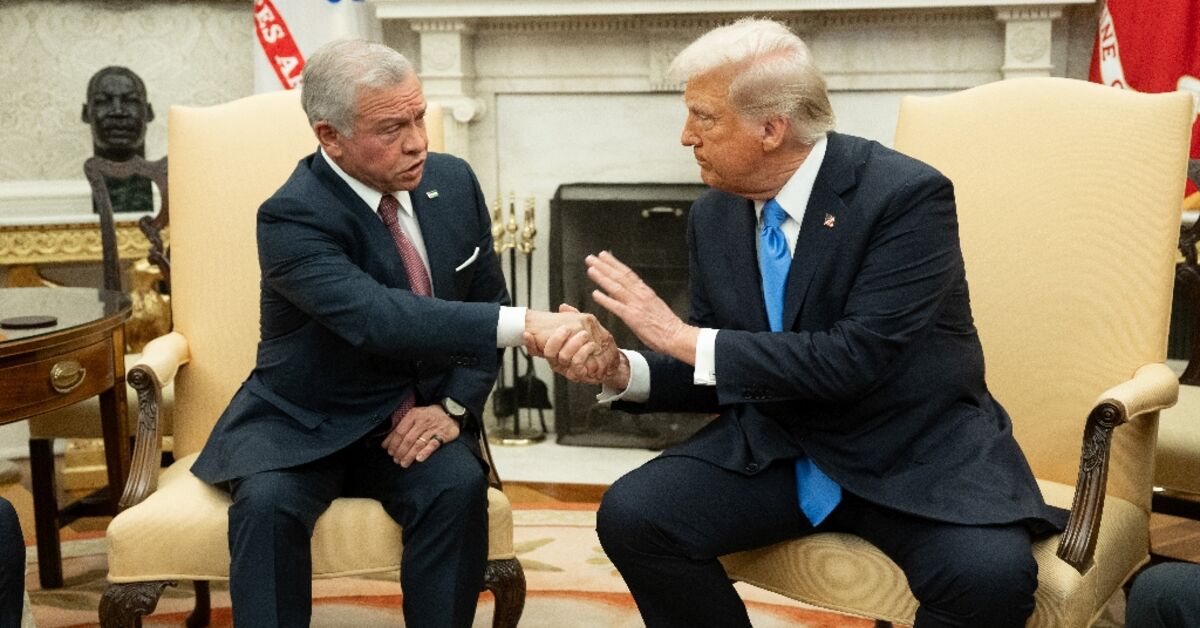
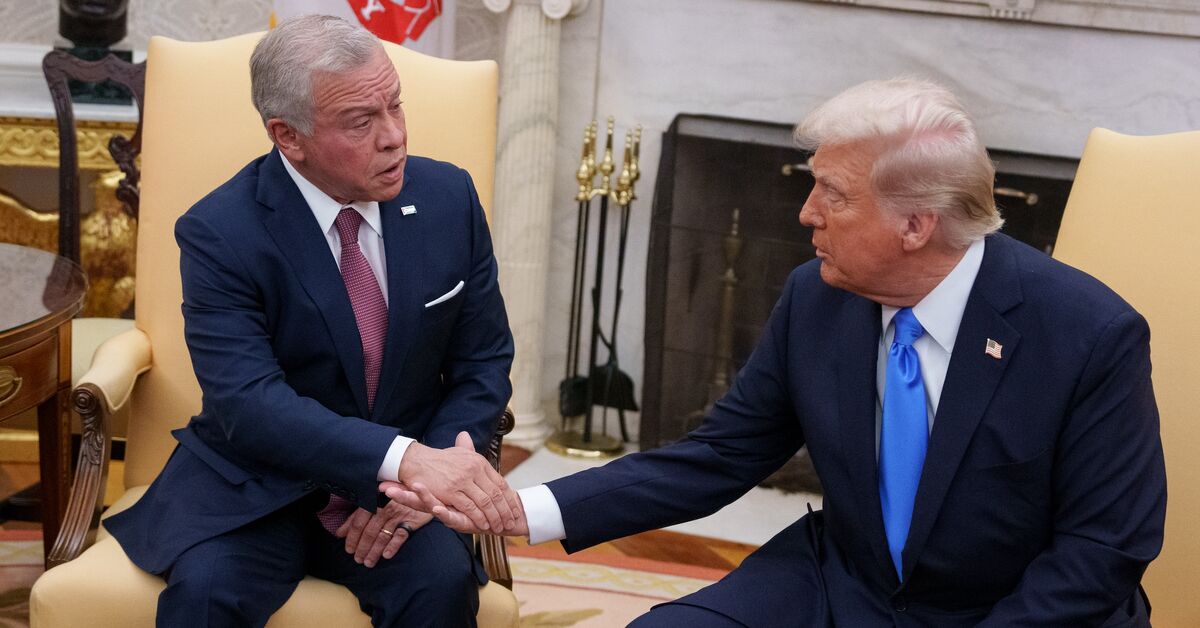

WASHINGTON — President Donald Trump on Tuesday insisted on US ownership of the Gaza Strip, but he walked back his threat from a day earlier to withhold aid from Jordan and Egypt if they don’t accept Palestinians forcibly transferred from the territory.
At the start of his meeting with Jordanian King Abdullah II, Trump told reporters the United States “will take over the Gaza Strip” and relocate its entire population to third countries, including Jordan.
“I believe we’ll have a parcel of land in Jordan. I believe we’ll have a parcel of land in Egypt,” Trump said.
Faced with pushback from Arab allies, Trump on Monday threatened to cut assistance to Jordan and Egypt — among the top recipients of US aid — if they rebuffed his demand to resettle Gaza’s Palestinian population. He retreated from his threat on Tuesday.
“We contribute a lot of money to Jordan and to Egypt, by the way, a lot to both. But I don’t have to threaten that. I think we’re above that,” Trump told reporters.
The United States has long been the largest provider of assistance to cash-strapped Jordan, which received nearly $1.7 billion in 2023. It gave Egypt roughly $1.5 billion.
Trump’s controversial proposal to relocate 1.8 million Palestinians to neighboring countries loomed over the king’s visit, the first by an Arab leader since Trump’s inauguration last month. King Abdullah has long said any attempt to forcibly resettle Palestinians in Jordan would be a “red line” for the Hashemite Kingdom.
Sitting next to Trump in the Oval Office, King Abdullah dodged reporters’ questions on the Gaza takeover proposal and suggested waiting until Egypt is able to formally present its own post-war plan to the United States.
“We have to look at the best interests of the United States, of the people in the region, especially to my people of Jordan,” he said.
US President Donald Trump (2nd-L), accompanied by US Secretary of State Marco Rubio (3rd-L), White House Chief of Staff Susie Wiles (2nd-R), and US national security adviser Michael Waltz (R), speaks during a meeting with Jordan’s King Abdullah II bin Al-Hussein (L) in the Oval Office of the White House, on Feb. 11, 2025, in Washington. (Photo by Andrew Harnik/Getty Images)
The king added that Jordan would resettle 2,000 children from Gaza who have cancer or are seriously ill “as quickly as possible,” an offer Trump called “a beautiful gesture.”
Trump first floated his idea to “buy” and redevelop war-ravaged Gaza last week during a press conference with Israeli Prime Minister Benjamin Netanyahu, who was the first foreign leader to visit the White House following Trump’s inauguration.
On Tuesday, Trump doubled down on his plan to permanently remove Palestinians from Gaza, claiming “they’re going to be in love” with the idea. He did not rule out sending US troops to the coastal enclave.
“As far as Gaza is concerned, we’ll do what is necessary. If it’s necessary, we’ll do that. We’re going to take over that piece that we’re going to develop,” Trump said.
Egypt, whose foreign minister, Badr Abdelatty, met with senior US officials in Washington on Monday, has also firmly rejected Trump’s Gaza plan. Egypt will hold an emergency Arab summit in Cairo on Feb. 27 to discuss “new and dangerous developments for the Palestinian cause.”
Trump has said Palestinians would not have a right to return to Gaza under his plans. His comments have evoked fears in Jordan of a second Nakba, a reference to the expulsion of at least 750,000 Palestinians from their homes in 1948 during the Arab-Israeli war that established the modern state of Israel. Far-right Israeli politicians and pro-settler movements have attempted to revive the idea of Jordan as an alternative homeland for Palestinians.
“For Jordan, it represents an existential issue,” said Merissa Khurma, program director of the Middle East Program at the Wilson Center.
“I do not see the Jordanian government moving their position on this, because they will pursue their national interest,” said Khurma. “And their national interest does not align with the forced displacement of 1.8 million Palestinians from Gaza.”
US President Donald Trump greets Jordan’s King Abdullah II bin Al-Hussein (R) and Crown Prince of Jordan Hussein bin Abdullah (L) as he arrives at the White House on Feb. 11, 2025, in Washington. (Photo by Win McNamee/Getty Images)
The king must balance aid-reliant Jordan’s dependence on the United States with domestic anger over US support for a war that’s killed more than 48,200 Palestinians, a majority of whom local health officials say are women and children. The Israel-Hamas war was triggered by the militant group’s killing of 1,200 people and abduction of some 250 others during its Oct. 7 assault on Israel.
King Abdullah’s visit comes as violence surges in the northern West Bank, where the Israeli military has widened the counter-terrorism operation it launched in Jenin last month. The Palestinian Authority’s Health Ministry said Sunday that Israeli gunfire in the Nur Shams refugee camp killed two Palestinian women, one of whom was pregnant.
The Jordanian government is concerned that instability in the neighboring West Bank could cause more refugee spillover. Jordan already hosts the world’s largest number of Palestinian refugees at more than 2 million, according to the United Nations.
The issue of forced displacement is a uniquely domestic one in Jordan, where more than half of the population is of Palestinian origin, including Queen Rania, who was born to Palestinian parents in Kuwait.
Jordan in 1994 became the second Arab country to make peace with Israel, and the two countries maintain close intelligence and security cooperation. In April, the Jordanian air force joined a US-led coalition to help defend Israel from an unprecedented Iranian drone and missile attack.
At the same time, Jordan’s leadership has been vocal in its criticism of Israel’s war in Gaza, with Foreign Minister Ayman Safadi among the first senior Arab officials to accuse Israel of genocide. Jordan recalled its ambassador from Tel Aviv in 2023, and protests are a frequent occurrence outside of the Israeli Embassy in Amman.
An Israeli source said Israel’s government believes Jordan could be doing more to prevent incitement against the Jewish state, pointing to provocations including a Jordanian official’s burning of an Israeli flag and a shawarma restaurant in Amman initially naming itself “October 7.”