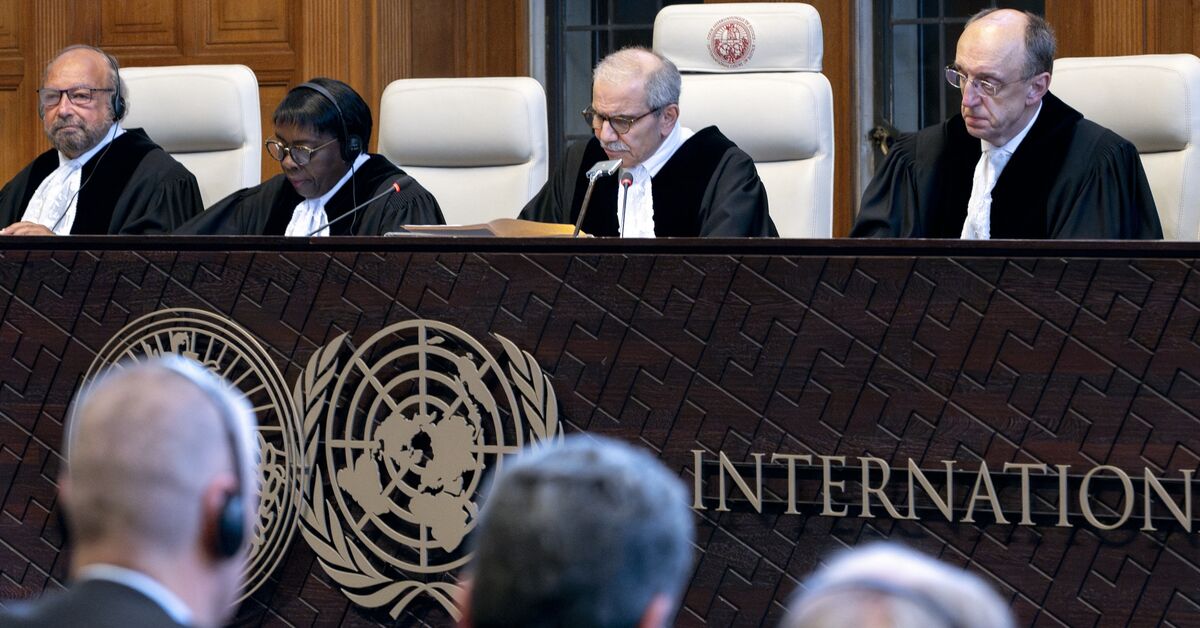

ANKARA — Turkey officially applied to the UN International Court of Justice to be a co-plaintiff in South Africa’s case against Israel, Turkish Foreign Minister Hakan Fidan said Wednesday, but Turkey’s official submission did not include a written commitment to accept that the judgment would be binding.
“Emboldened by the impunity of its crimes, Israel is killing more and more innocent Palestinians each day,” Turkish Foreign Minister Hakan Fidan said on X after the official submission to the United Nations’ highest legal body based in The Hague.
“The international community must do its part to stop the genocide and exert the necessary pressure on Israel and its supporters.”
South Africa brought the case in December, claiming that Israel’s actions are in breach of the 1948 UN Genocide Convention. In an interim ruling in January, the court established the risk of genocide against Palestinians in Gaza and ordered Israel to ensure its forces refrain from acts of genocide in the enclave.
The court also ordered Israel to ensure the flow of more humanitarian aid into the Palestinian enclave in its interim ruling, but the final judgment by the court could take years, as many other similar cases brought to the court have shown.
Turkey had announced its intention to join the case in May and said that preparations for the application were underway.
The country became the seventh country that submitted such a request since its filing in December. Spain, Mexico, Libya, Colombia and Nicaragua submitted their declarations of intervention in the proceedings over the past months.
In addition, Palestine, which holds only a nonmember observer state status in the UN, also requested permission to join the case. If their requests are granted, Turkey and others will be able to file written submissions and speak at public hearings.
Article 63 of the statute states that parties have “the right to intervene in the proceedings” but warns that invoking this right will cause the interpretation of the Genocide Convention in the court’s judgment to be “equally binding upon” every country that intervened in the case.
Every other applicant declared in their submissions that they understood and accepted that the interpretation of the Genocide Convention in the final judgment of the court would be binding for the co-plaintiff country as well.
Unlike other applicants’ submissions, Turkey’s stood out for not including a written commitment to acknowledge the ruling as binding, a copy of Turkey’s submission on the court’s website showed.
According to experts, the absence of such a declaration in the official submission is linked to Turkey’s decades-long efforts to prevent the recognition of the mass killing and deportation of Armenians by the Ottoman Empire during World War I in 1915 as genocide. The United States and several European powers recognize the killing of hundreds of thousands of Armenians as a genocide.
According to Alper Coskun, a former Turkish ambassador and current senior fellow at the Carnegie Endowment, Turkey likely refrained from such an acknowledgment out of caution.
“Even though the investigation concerns Israel’s actions, the exact actions that would be interpreted as criminal and included under the scope of attempted genocide cannot be known from the onset,” he told Al-Monitor.
The 1948 Genocide Convention cannot be “applied retroactively,” Coskun said. Since the Genocide Convention was signed in 1948, Turkey cannot be prosecuted for 1915 massacres under the convention.
Nonetheless, “Turkey might have sought to avert an upsetting ‘precedent’ that could be binding on itself,” Sinan Ulgen, senior fellow at the Carnegie Endowment for International Peace think tank, told Al-Monitor.
Linking the absence of the declaration to a simple overlook would be “unrealistic,” Ulgen said. “It is certain that a legal assessment was conducted and adoption of this method was decided,” he added.
Namik Tan, a former Turkish ambassador to Washington and Israel and a lawmaker for the main opposition Republican People’s Party, warned earlier this week that Turkey should be “aware of the possible consequences of Article 63” before intervening in the genocide case against Israel.
Another explanation might be Turkey’s unwillingness to drop genocide accusations toward Israel.
If the court rules that Israel did not commit genocidal acts in Gaza, “Turkey will be bound by this ruling, and it won’t be able to claim ‘Israel committed genocide’ after that,” Riza Turmen, a former judge on the European Court of Human Rights, told Deutsche Welle’s Turkish service on Wednesday.