
ANKARA — The Islamic State claimed responsibility for an attack on a Roman Catholic church in Istanbul on Sunday that killed one person. Experts see the footprints of the extremist jihadi group’s Khorasan branch.
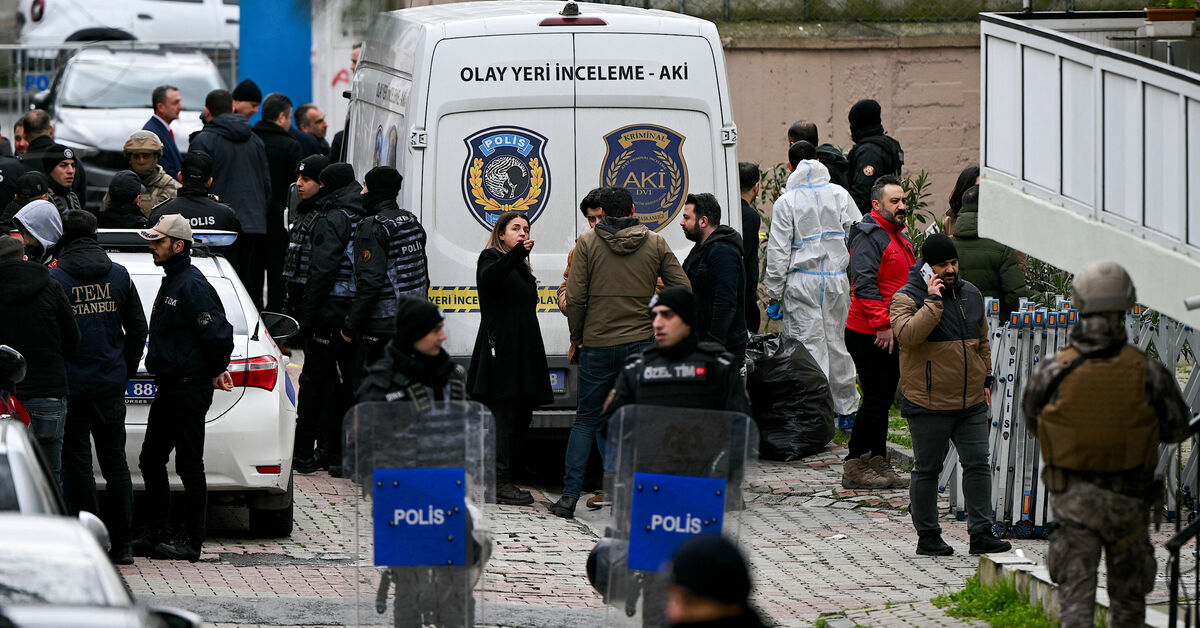
Two balaclava-clad assailants raided the Santa Maria Catholic church in Istanbul’s Sariyer district during the Sunday service and randomly shot at the crowd, killing 52-year old Tuncer Cihan before escaping the scene. Cihan, who was buried in a Muslim ceremony, was an occasional visitor to the church, local news outlets reported.
Briefing the press Sunday midnight, Interior Minister Ali Yerlikaya announced that two murder suspects were caught, identifying them as a Tajikistani and a Russian national.
“We think that these two foreign nationals, one from Tajikistan and the other from Russia, are Daesh members,” he said, using the Arabic acronym for the Islamic State militant group.
Yerlikaya added that roughly 50 individuals were also detained over suspected links to the attack in raids at 30 different locations in Istanbul. Among those detained, some 23 foreigners without residency permits will be deported from Turkey even though no links were found between them and the attack, according to Turkey’s private Demiroren News Agency.
“Istanbul has been home to different religions and sects for centuries and it will continue to do so,” Yerlikaya said, adding that more than 2,000 individuals had been detained and nearly 530 arrested since June as part of a national counterterrorism operation against the organization.
Yerlikaya provided no further information on the assailants. The two suspects were caught in Istanbul’s Basaksehir neighborhood, which is home to a large expat community from the Middle East and Central Asia, Demiroren reported Monday.
The report identified the suspects by their initials A.K. from Tajikistan and D.T. from Russia.
Erdogan conveyed his condolences to Santa Maria’s priest, Anton Bulai, and his good wishes to Poland’s consul general to Istanbul, Witold Lesniak, who was also at the church during the attack, in a phone call on Sunday. The diplomat and his family survived the attack without injuries.
Italian Prime Minister Giorgia Meloni, who visited Istanbul on Jan. 20, strongly condemned the attack on the social media platform X, while Pope Francis expressed his sympathy for the community.
On Monday, Ecumenical Patriarch Bartholomew I, spiritual leader of the world’s Orthodox Christians, paid a condolence visit to the church
The church shooting marks the first likely attack by ISIS-Khorasan in Turkey. The offshoot of the Islamic State formed in 2015. It’s the first ISIS attack in the country since a mass shooting at an upscale Istanbul nightclub during a New Year’s Eve party in 2017 that killed nearly 40 people. The militant group carried out several attacks across the country between 2013 and 2017, including a suicide bombing at a peace rally in Ankara that killed more than 100 people and wounded 500, marking the bloodiest attack in the country’s history.
Rise of Tajikistani militants
Last month, Turkish authorities detained nearly three dozen ISIS suspects for planning to attack synagogues and churches in Istanbul.
However, unlike Syrians, Iraqis and Afghans, Tajikistani and other Central Asian nationals could find it easier to blend into Turkish and Iranian societies and launch attacks undetected, Cagatay Cebe, a Turkey-based independent researcher who closely follows jihadi movements including ISIS, told Al-Monitor.
ISIS-K’s most recent attack, earlier this month in the Iranian city of Kerman, killed more than 90 people.
“ISIS has been carrying out almost all of its operations in Afghanistan, Iran and Turkey through Tajikistanis for the last two and a half years,” Cebe said.
Unlike Middle Eastern militants and their networks, which have been closely monitored by Turkish intelligence agencies, Tajikistani and other Central Asian operators have largely flown under the radar, allowing them to operate with greater freedom throughout the country, Cebe added.
Footprint in Turkey
Riccardo Valle, director of research at the Islamabad-based media platform The Khorasan Diary, also closely follows ISIS and other jihadi groups. He described the Khorasan branch to Al-Monitor as “the most internationalized branch” of the jihadist group as a result of its latest attacks in Afghanistan and Iran. He added that the group “mainly operates in Afghanistan and Pakistan in terms of attacks, but is capable of reaching out to Central Asia, Iran and [Turkey] for different reasons; either to conduct attacks, recruitment or funds.”
He also pointed out that the extremist group referenced its so-called “Turkey province” for the first time after Sunday’s attack, signaling that its presence in the country is well established.
“Usually it means that there is a proper structure and chain of command. This has been proven by Turkish counterterrorism efforts in 2023, which have dismantled many cells of IS in the country,” Valle told Al-Monitor in written comments.