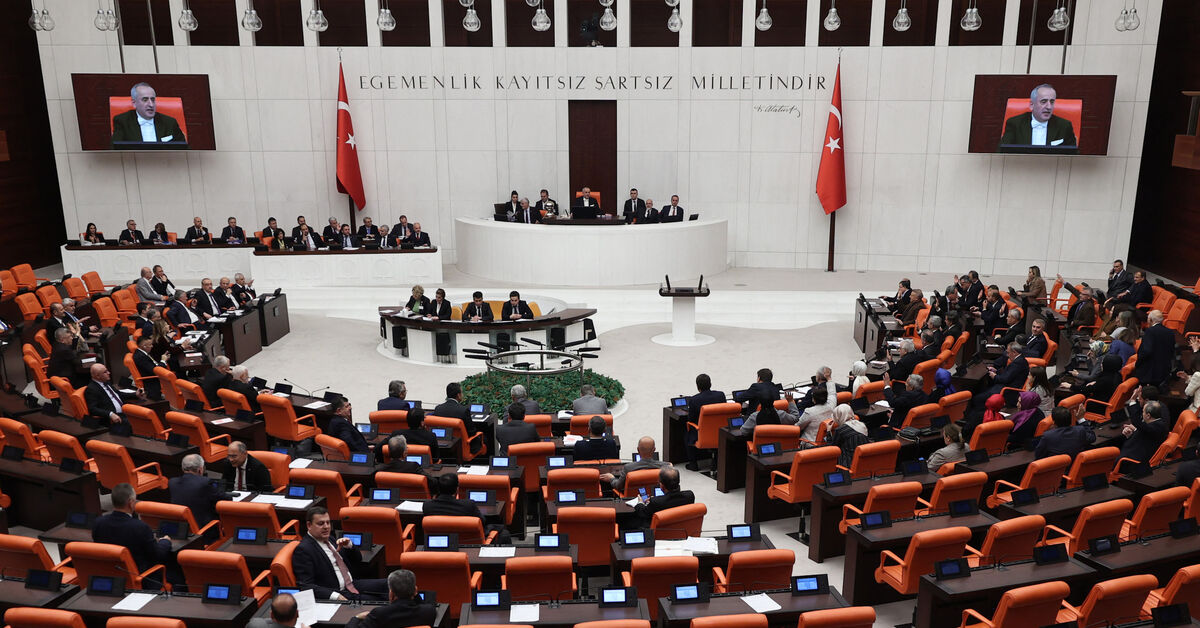


ANKARA — Turkey’s parliament ratified Sweden’s long-stalled accession to NATO on Tuesday.
The expansion was ratified by the majority as several opposition parties as well as Islamist parties within the Turkish president’s election alliance voted against the protocol.
Among 346 lawmakers present on the floor, 287 voted in favor of and 55 against the Swedish accession, with four abstaining.
The process, which took more than a year and a half, sped up last month following a phone conversation between Turkish President Recep Tayyip Erdogan and US President Joe Biden.
Stockholm amended its constitution and its counterterrorism laws to address Turkey’s national security-related demands in return for its green light for Sweden’s accession to the transatlantic alliance. Yet a series of hurdles delayed Turkey’s ratification, including Ankara seeking guarantees over its pending bid to purchase 40 new F-16 fighter jets from the United States, for which NATO expansion became a key foreign policy issue following Russia’s invasion of Ukraine in February 2022.
Turkey, the NATO member with the second-largest standing military after the United States, announced its bid to buy 40 new F-16 fighter jets and nearly 80 modernization kits for $20 billion in 2021. The Biden administration publicly endorsed the sale last year, but the State Department has still not given Congress official notice on the transaction.
Following his phone call with Biden, Erdogan said the US leader assured him that the sale would be sealed following Turkey’s ratification of the Swedish membership in NATO.
Abandoning its military non-alignment policy along with Finland, Sweden announced its bid to join NATO in May 2022. Both Nordic states were officially invited to NATO in June 2022 during the alliance’s Madrid summit. The two countries’ NATO bids were widely seen as a move to shore up security in response to Russia’s invasion of Ukraine.
Turkey, for its part, tabled a series of demands in return for its approval of the NATO expansion, as the decision-making process in the security alliance is based on consensus.
Ankara demanded the Nordic states deliver a large-scale crackdown on groups and individuals it deems terrorists, including Kurdish groups, and lift the de facto defense sales restrictions both countries slapped on Turkey over its military operations in northern Syria against Kurdish-led Syrian Democratic Forces, the top ally of the US-led international coalition against the Islamic State.
Following the lifting of the arms embargo against Turkey, Finland became a member of the alliance in April. Yet Sweden’s accession process has been a seemingly endless saga. Despite Stockholm amending its counterterrorism laws as well as its constitution to address Ankara’s concerns, a series of demonstrations against the Turkish government by Kurdish activists and Quran-burning protests held in Sweden derailed the process.
Ankara also seized the occasion to raise longstanding grievances with its NATO allies, including what it described as the alliance’s lack of support in Turkey’s fight against terrorism. It also brought up arms embargoes by other NATO countries including the Netherlands and Canada and its pending F-16 bid as part of negotiations. To convince Ankara, NATO established the post of special coordinator for counter-terrorism for the first time in history. The Netherlands lifted its defense sales restrictions on Turkey last year.
This is a breaking story and will be updated.