
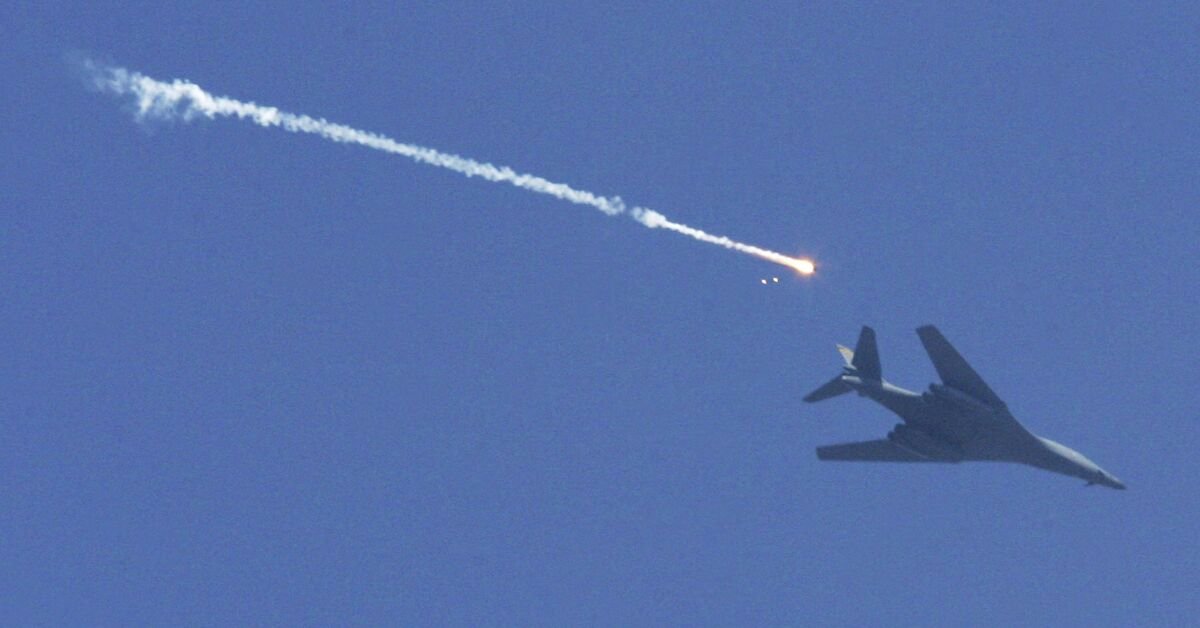

WASHINGTON — US B-1 bombers led airstrikes on more than 85 targets linked to Iran’s Islamic Revolutionary Guard Corps (IRGC) and the militias it backs across Syria and Iraq on Friday night in retaliation for a drone attack that killed three US soldiers at a base in Jordan last Sunday.
US warplanes dropped more than 125 precision munitions on the targets, which “included command and control operations, centers, intelligence centers, rockets, and missiles, and unmanned aerial vehicle storages, and logistics and munition supply chain facilities,” US Central Command said in a press release.
The scope of the strikes marked an unprecedented US retaliation against IRGC-backed factions that have launched more than 160 attacks on bases used by US troops in Iraq and Syria amid Israel’s war in the Gaza Strip.
In a statement Friday evening, President Joe Biden said that strikes hit targets “the IRGC and affiliated militia use to attack US forces.”
“Our response began today. It will continue at times and places of our choosing,” he added.
Gen. Alex Grynkewich, the top US Air Force commander in the Middle East who oversaw the strikes from the combined air operations center at al-Udeid Air Force base in Qatar, billed the strikes as “defensive” in a statement.
Following a series of meetings with top national security advisors, Biden on Wednesday said he had come to a decision on the response, which administration officials this week said would come in phases.
“The president has directed additional actions to hold the IRGC and affiliated militias accountable for their attacks on US and coalition forces,” Defense Secretary Lloyd Austin said following the first round of strikes on Friday night.
White House National Security Council coordinator John Kirby said the first action taken in response to the Tower 22 attack wouldn’t “be the last” seen from the US.
While no specific militia claimed credit for the attack, the Pentagon has said it bore “the footprints” of Kataib Hezbollah. White House and Pentagon officials this week attributed the lethal incident to the self-styled “Islamic Resistance” movement in Iraq, an umbrella term for Iran-backed militias that includes Kataib Hezbollah and others.
In an apparent last-ditch attempt to save face, Kataib Hezbollah announced on Tuesday it was suspending attacks against US forces in Iraq and Syria, implying Iran was not privy to its attacks. The statement emerged amid a visit by the commander of the Quds Force of Iran’s IRGC to Baghdad.
“The president will not tolerate attacks attacks on American troops, and neither will I,” US Defense Secretary Lloyd Austin said Thursday in his first press briefing at the Pentagon in more than a year.
Asked by Al-Monitor why the US had decided to respond in phases, rather than a single decisive retaliation, Austin replied, “I don’t think the adversaries are of a ‘one-and-done’ mindset. They have a lot of capability. I have a lot more.”
This is a breaking story and will be updated.