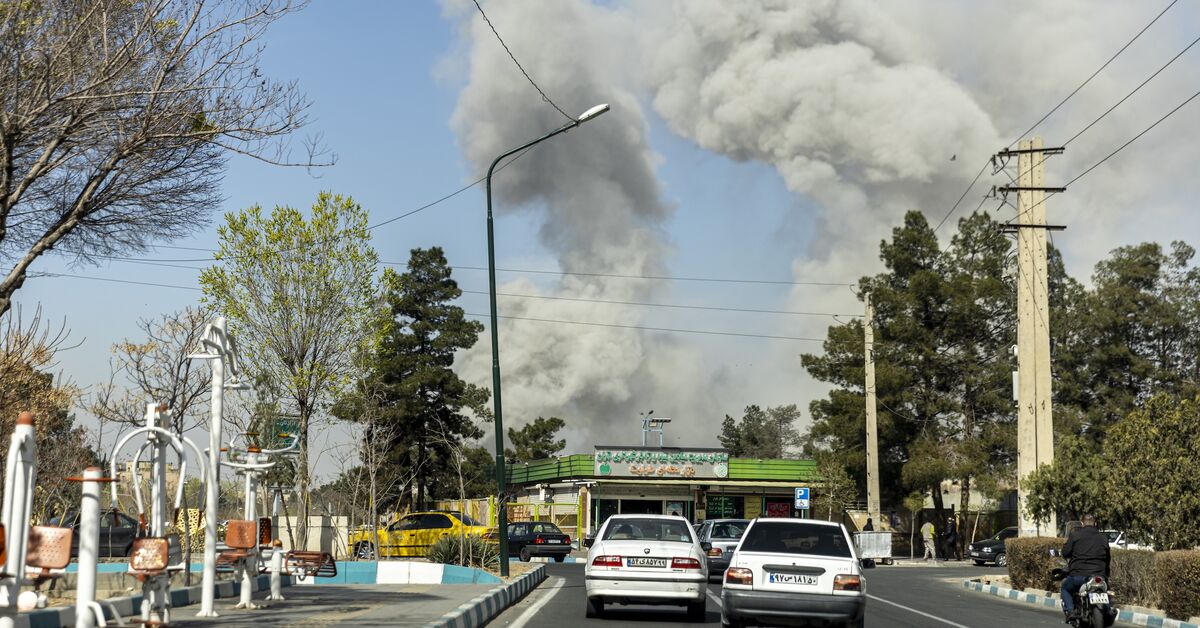


With further negotiations pencilled in with the US and perhaps assuming that any assassination attempt would take place at night, Iranian supreme leader Ali Khamenei was at his complex in Tehran last Saturday morning. It would be his last.
An air strike obliterated the compound in Tehran where a gathering of key decision-makers was taking place, killing Khamenei, his wife and other top officials.
As the US and Israel have pounded Iran with thousands of attacks over the last week, some details have emerged about how their intelligence services, the CIA and Mossad, set up an operation that has demonstrated once again the extent to which Iran has been penetrated.
According to statements from US officials, it was an Israeli strike made possible through US and Israeli reconnaissance and communication intercepts.
The New York Times reported that the CIA (Central Intelligence Agency) gave the Israelis details on Khamenei’s location at dawn on the day of the strike.
According to the Financial Times, almost all road‑surveillance cameras in Tehran had been hacked years ago by Israel, with their encrypted feeds transmitted to servers there.
One camera had a particularly useful angle on the supreme leader’s compound on Pasteur Street in central Tehran, enabling the identification of guards, their routines and movements, the paper reported.
“We knew Tehran like we know Jerusalem,” an Israeli intelligence official told the paper.
– Mossad reputation –
An unknown number of senior Iranian security officials were killed alongside Khamenei.
Iranian media have confirmed the deaths of army chief of staff Abdolrahim Mousavi, Revolutionary Guards commander Mohammad Pakpour, the defence minister, the head of the police intelligence unit, and others.
Unconfirmed Israeli media reports have claimed that a photo of Khamenei’s corpse was sent from the scene, with columnist Ben Caspit writing that “when the details of his assassination become clear, jaws will drop”.
“Iran was caught with its pants down. The opening strike will be studied by military colleges around the world for years to come,” Caspit wrote in the Maariv newspaper.
For military affairs expert Yossi Yehoshua, writing in the daily Yedioth Ahronoth, Khamenei’s killing “changes the entire balance of deterrence in the Middle East and puts Israel in a position of advantage it has never known before”.
Other commentators and experts have warned it also creates a dangerous precedent for the assassination of an internationally recognised leader.
While Israel’s domestic security agencies were widely criticised over their failure to detect and prevent the deadly Hamas attack on October 7, 2023, foreign intelligence service Mossad has burnished its reputation since.
High-profile assassinations have included the head of Hezbollah, Hassan Nasrallah, in Beirut and top Hamas leaders, like Ismail Haniyeh who was killed in Tehran.
Israel also killed and maimed Hezbollah operatives in Lebanon in an astonishing attack that saw tiny explosives hidden inside pagers used by the Iran-allied group which exploded when detonated remotely.
Yehoshua said Israel’s capacity for such operations was clearly growing and in killing Khamenei, it “reached a level of artistry with what may have been the greatest targeted assassination in history.”
– ‘This isn’t Las Vegas’ –
Israeli investigative journalist Ronen Bergman, the author of a best-selling book on Mossad, noted that Khamenei did not live in hiding.
“It’s like having a sign on his door saying: ‘Here lives the Happy Khamenei Family’,” he joked on social media.
But others have speculated that Khamenei, at age 86, was prepared to accept death in what he saw as martydom, or that he felt confident that international norms against assassinating sovereign leaders would offer protection.
A former French military officer and expert on several conflicts, who requested anonymity, told AFP that the full impact of Khamenei’s death remains to be seen.
“The details of covert operations — unlike air campaigns — are by definition extremely hard to know and are a major communications battleground,” the expert told AFP.
“The intended message is that this was a ‘clean, precise, flawless’ operation that decapitates a regime in one blow and reshuffles the deck,” the source said.
“But the other side is not playing poker. This isn’t Las Vegas. They’re playing chess — and losing a major piece does not end the game.”