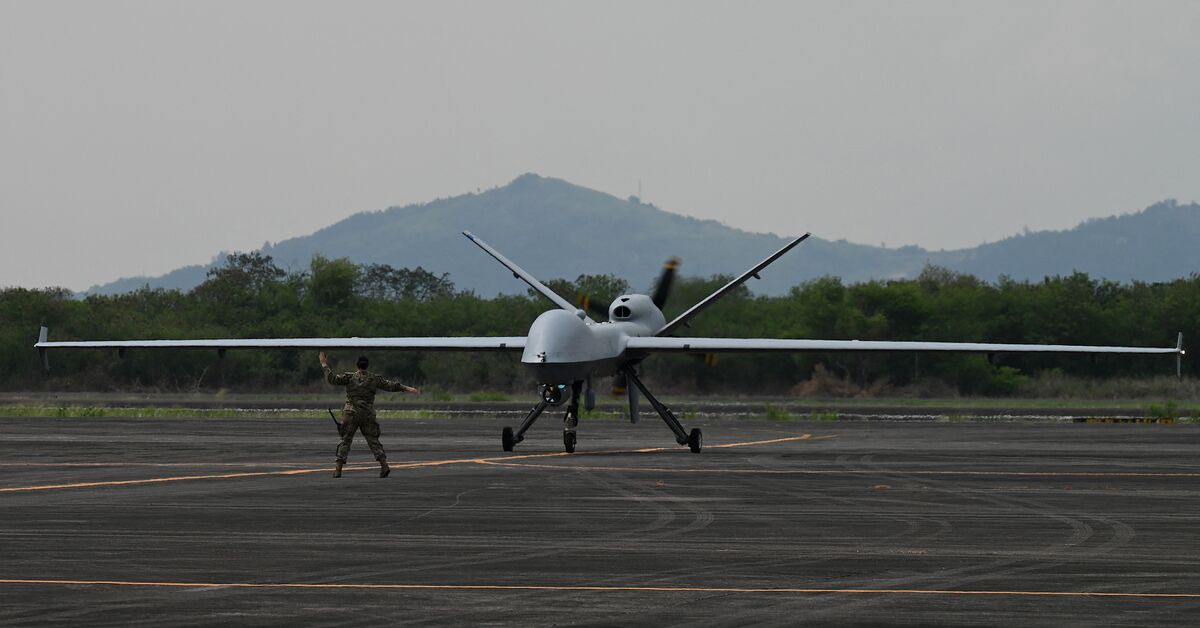

WASHINGTON — Russian fighter jets maneuvered dangerously close to three US MQ-9 Reaper drones over Syria on Wednesday in what the US military described as the latest case of deliberate harassment by the Kremlin’s forces there.
The US Air Force released video of the incident captured by an MQ-9’s camera in which at least one Russian Su-35 appears to stall in close proximity to the drone. In another clip, a Russian plane appears to drop flares within close range of one of the drones.
The Air Force’s top commander in the Middle East, Lt. Gen. Alexus Grynkewich, said in a statement that the close encounter occurred as the three US MQ-9s were “conducting a mission against [Islamic State] targets.”
3 Russian fighter jets harassed US drones over Syria, US Air Force says
The jets dropped flares and flew in front of the drones, forcing them to take evasive action. The US military called the incident “unsafe and unprofessional.”#Russia #Syria #Drones #USMilitary pic.twitter.com/0eU3IvOS3r
— International Defence Analysis (@Defence_IDA) July 6, 2023
Grynkewich explained, “Against established norms and protocols, the Russian jets dropped multiple parachute flares in front of the drones, forcing our aircraft to conduct evasive maneuvers.”
The statement went on, “Additionally, one Russian pilot positioned their aircraft in front of an MQ-9 and engaged afterburner, thereby reducing the operator’s ability to safely operate the aircraft.
“We urge Russian forces in Syria to cease this reckless behavior and adhere to the standards of behavior expected of a professional air force so we can resume our focus on the enduring defeat of ISIS.”
Why it matters: This is the first video released by the US military showing aggressive maneuvers by Russian pilots over Syria since CENTCOM officials began raising the alarm over such incidents earlier this year.
There are roughly 900 US troops in Syria supporting local fighters in tracking down the remnants of Islamic State networks. American troops, who officials say are only there to fight IS, share a crowded battlefield with Russian, Syrian and Iranian forces who support the government of Syrian President Bashar al-Assad.
Over the past several months, Russian pilots have repeatedly flown weapons-laden aircraft over exposed US bases in Syria, violating safety protocols and prior agreements with US commanders, American officials have said.
In March, the top commander of US forces in the Middle East, US Army Gen. Michael “Erik” Kurilla, alerted Congressional lawmakers about a spike in the frequency of such incidents.
Grynkewich later told NBC News that Russian pilots had flown over the US Al-Tanf garrison on Syria’s southern border with Iraq and Jordan some 25 times in the first three weeks of that month.
Russian pilots have periodically violated US-controlled airspace over Syria over the past several years, but it remains unclear why they are ramping up the pressure now.
Officials at CENTCOM’s Air Force headquarters first noticed the current trend around the time of Russia’s invasion of Ukraine in February 2022, one military official at told Al-Monitor last month.
Grynkewich and other US military officials told Al-Monitor earlier this year they suspected that Russian harassment could be in part a favor to Iran, whose steady supply of armed drones has helped the Russian military bombard Ukraine.
Iran-backed forces in Syria and Iraq are long thought to have coveted the border crossing between the two countries on the Baghdad-Damascus highway, where the US Al-Tanf base sits surrounded by a no-fly zone with a 55-kilometer (34-mile) radius.
A classified Pentagon document leaked online and reported by the Washington Post last month revealed that Russian, Iranian and Syrian military and intelligence officials held a meeting in November 2022 in which they agreed to establish a coordination center to direct a campaign of covert pressure on the US footprint in Syria, including stoking protests and attacks on American forces.
A US military official told Al-Monitor last month that the so-called de-confliction channel — a phone line between US and Russian commanders in Syria designed to reduce the risk of violent confrontation — remains active.
Know more: Last month the Pentagon dispatched high-value US F-22 Raptors — the United States’ most advanced fighter jet — to Jordan to ward off Russian planes over Syria, but military officials don’t expect their deployment to be long-term.